Friday, 3 March 2017

Assemblage work

Collage: noun
1. A technique of composing a work of art by pasting on a single surface various materials not normally associated with one another, as newspaper clippings, parts of photographs, theater tickets, and fragments of an envelope.
2. A work of art produced by this technique. [Compare Assemblage]
3. An assemblage or occurrence of diverse elements or fragments in unlikely or unexpected juxtaposition:

Assemblage: noun
1. A group of persons or things gathered or collected; an assembly; collection; aggregate.
2. The act of assembling; state of being assembled.
3. Fine Arts:
  1. A sculptural technique of organizing or composing into a unified whole a group of unrelated and often fragmentary or discarded objects.
  2. A work of art produced by this technique.
    [Compare Collage]

After discussing in my tutorial ideas surrounding language, fragmentation and these trajectory lines, I took the opportunity to reflect on the idea of producing a body of collage based work that was potentially the first piece of work in the collection. These individual pieces would structure both text [taken form de Certeau's 'walking in cities' ] and various papers and cards, [using both materiel from the galleries visited and a reduced colour palette of that used within the gallery]. There is something extremely therapeutic yet requires a high level of concentration when constructing this images. I wanted to juxtapose both the text with fragmented forms that would on one level start to visualize what the text said and on another level have a visual link to the forms that have arrived form my trajectory work. 

I have started with ten although depending on how these start to shift my view and the impact they create it would be interesting to move into a larger amount. If I am to consider these as pieces of work that would introduce the project and be placed in one of the galleries [hypothetically] then i need to consider how many I would require to fill that space.


Text taken from 'Cut & Paste: 21st Century Collage'
Collage is a medium that connects the past with the present, sometimes offering a glimpse of what may be the future. Contemporary collage has become a significant part of our visual landscape. the fusion between disparate and juxtaposed assemblage images provokes questions, ambiguous questions that we may not be able to answer.

Thursday, 2 March 2017

CRP - update

This week in replace of our studio practice tutorials, we had the chance to meet with a tutor and review our CRP progress. We were asked to increase our CRP [critical research paper] to 1000 words, however I just didn't have the time nor did I want to put anything down that hadn't had the appropriate time given to it. That said, and ti avoid the tutorial becoming useless [partially by my own fault] I arrived with a set of questions relating to the structure of my witting. I have been recently reading two essential books, one that focuses on past critiques of architecture and analyzes articles and their structure, shape and content. the other is a student guide to research methodologies in architecture and there was a dedicated chapter that outlined the writing, in particular at postgraduate level. For me I need an aim and POA of what I see the final submission containing. The CRP needs to provide a balance of practice and theory intertwined with reinfection, arguments, debates and precedents being used to shape the opinion and influence the practice.  I now want to set myself a target on writing a vast amount of the CRP over the Easter break whilst I am away from the studio. the expected submission for unit 02: is 2000 words but it would be great to push that further.


The writing style must be academic and must construct an argument and opinion. Because my project consists of several elements, I am going to structure my CRP in a way that addresses each body of work individually, with their own precedent that is in constant dialogue with the context surrounding the museum/gallery. The following is the proposed plan of structure:

01. Introduction: address aims, address sections [do not call them chapters] discuss in light the gallery and surrounding issues

02. Context: A critique of the gallery/museum with reference to theory and text. move into the discussion of the main key text [walking in cities] and link in with narratives, trajectories.

03. body of work 1: Include precedents and the relationship between them, you and the gallery

04. body of work 2: Include precedents and the relationship between them, you and the gallery

05. body of work 3: Include precedents and the relationship between them, you and the gallery

06. Conclusion: Argument and impact of studio work

07. Summary: Each chapter ? I have seen this within academic texts before but do not want to find myself repeating section 06
 

Monday, 27 February 2017

Student Seminar progress

As we regrouped this week in discussing our initial findings relating to 'material narratives', we had the opportunity to put in place a plan of what we were communicating in relation to the seminar group title and our approach.  The rest of the group didn't really have much to add on from what I presented to them. I had been thinking about how we could use the upcoming Wayward event as a way to produce responsive research that we could then publish. I had seen and spoken to some of my group peers on the Friday and shown them what I was working on already, so it was un-collaborative and a let down in a way to see that none of them had decided to contribute and push their own ideas forward. The initial thoughts behind the group was the mapping of our own locations and routes. I decided to move this on given the feedback we received about materials and that Pete was interested in the idea of process. 

I had been playing around with the idea of casting mundane objects, that we come into contact with on a daily basis and use these as potential 'social objects'. The idea would be that visitors of the Wayward event would take one of the casts [in which the plan was to have multiples] and to map the objects new location. 


Upon presenting this back to Pete, he felt that the object needed further justification and questioned us over 'what we were trying to say, solve, present?'. It is frustrating because the idea was solo mine, but I do agree that there was something missing. Need to further question why we are doing what we are. We also had to later on share our views back to the other students and out of this, I did start to question "social interaction and perhaps public engagement' within an arts based context. Thinking about audience participation within galleries [something that has been flagged up during my main project research and tutorials]. I think the idea of an art kit or a one minute sculpture pack could be really interesting. it would provide at the very least an opportunity for a discussion around audience participation. 


At the end of the presentations it became clear that the original idea or opportunity to present or have work at the Wayward event wasn't going to be realistic nor possible. The notion of having this at our interim show was suggested, which if I am honest just puts this already half-heated seminar group on a back foot and that for me personally, I have other more main project focused work that I would like ot focus on both up to and during the interim show. It is certainly starting to feel like the idea of these seminar group projects hasn't really been considered . . . what do they want? for now though I do have a collection of three very aesthetically pleasing paper weights.

Drawing Spaces Lecture 07: Depicting Measure

Gordan Matta Clark: retrospective "You are the measure"


How do we communicate scale and measurement in a creative way?

Russell Bell / Simon Elvins - Map of London's silence
Studio Myerscough - way finding systems - exploring green space in London boroughs

Mapping Space - Visual Translation and transformation

Matta Clark: Measuring and the production of forensic drawings of spaces - cutting and pasting text 'strata' - a geographic fiction. Combined with Robert Smithson. Entropy - organized breakdown of the elements]


Studio Forensic Architecture: Working with the ideas of post-conflict architecture [working at 1:1 scale through the method of drawing

James Corner: Taking measurements across the landscape - visualizing these. Images that are scales yet depict a scale through combined imagery. Landscape architecture that provides motif - narrative and variation of programme.

  
Valerio Morbito: Constructing terrains. working with both memory and landscape.

Conrad Shawcross: Inside the cube - understanding processes to push the work. Working with materials and thinking through making. using technology to allow the audience to engage with the space.
 

Dahn Vo: Where the lions are: Integrated in the collision between space and time. A curated exhibition working with multiple scales. Wallpaper that has printed replicas of 1:1 botanical illustrations.

Walter Pichler: Architectural drawings of texture and details. the human figure is included to depict spatial understanding. The understanding of the scale, body, material is emphasized into the drawings.

Will Alsop: Playing with expression, material and scale. Conceptual painting to depict proposals for architectural spaces. Ideas of a material landscape.


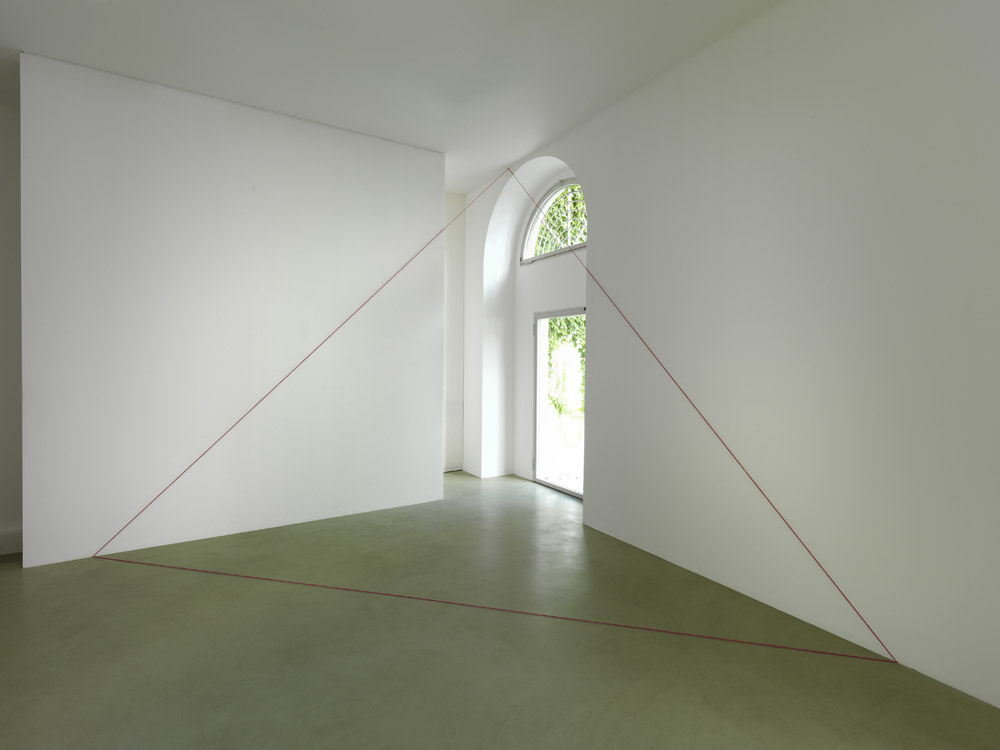
Fred Sandback: Conceptual minimalist drawings. sculptures at 1:1 that impose the viewer to suggest alternative spaces, planes and geometry. skewing space.


Friday, 24 February 2017

Library session

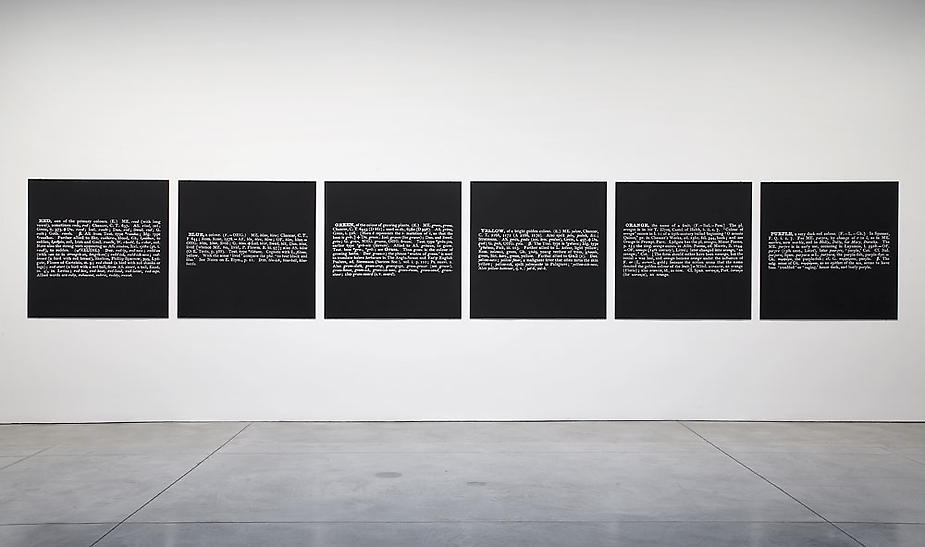
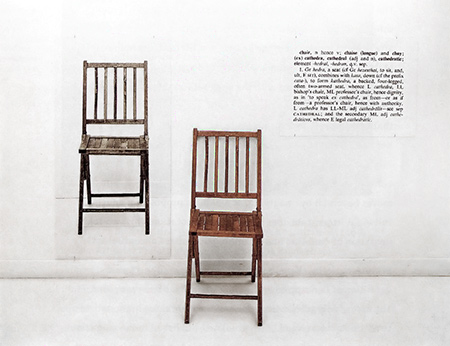
After discussing how relational 'art and language' was to my project and being introduced to the work of Joseph Kosuth, who has worked with language himself there was a library session needed to find some content that would help me with the critical research paper and the above context: The following text is from Joseph Kosuth" No thing, No self, No Form, No principle (was certain)


"What is assumed about the viewer/reader experience that precedes the point of reception. Arts requires a habituated experience - has art become entertainment driven. The other relationship is engagement. Enters into the process and participators in the production of meaning. Functions as the interface between two sides of a subjective."

"Elements of construction - the fragmenting of meaning, part of Robert Musil's practice was an attempt to rupture his own habituated relationship with language with begun with convo's of the practice of writing."  

Ex-Libris: A project of Jospeh Kosuth
"An additional layer of meaning is introduced through multiple languages. Impending loss of meaning, unsolvable indifference and partial blindness symbolized by white blanks."


"A continuous white line running around the room divided the exhibition space in half. By these simple means, an essential principle of the story - the perception of imagined and actual worlds - was made manifest" 

"Spanning the temporal and spatial realm of the text. As parts of the text are made illegible, they can only be read in context, as partial meanings."

Franz Kafka - translating and annotating


"Kosuth has been working with types . . .like language they are used as a material and transformed into new contexts. "the circularity of language".

This idea of working with language, questioning language and almost reformatting it to extend and develop a practice has close relations to my own work. The conceptual artists worked with language to a large extent as that if the international situationists who produced manifestos and whose work starts to make reference to the 'derive' the journeys taken.

Thursday, 23 February 2017

Mobile Archive: Project launch

Despite term two being crazy with work load and attempting to resolve such a large project, this term is also about taking on additional opportunities. The course as mentioned previously has provided us with the opportunity to take on some additional project, to help stretch our practice and portfolio. Tonight was the launch of the 'mobile archive project'. This project involves the collaboration of MAISD students, Sue Ridge [supported by Ken Wilder] and the UAL special collections archive form each of the six colleges. The brief . . well that is what we write tonight, an archive system and portable museum that can display an array of products form each of the collection. Sue who is leading the project is also working with the archives and is also producing a body of x-rays, yes x-rays of the objects that will support the exhibition. It is a really exciting project, it has a budget, and it is on the ten of us who have signed up to the project to design a proto-type. 

The first meeting was really an opportunity to meet with Sue and to start defining some of the parameters of the project. 

- There will be three items taken from each collection to be exhibited
- The structure must be easily portable and the scale must be supportive of working on each site [lifts/doors etc]
- X-rays will be presented alongside the objects
-elements could include: light boxes, shelves, drawers, instruments [magnifying glasses and white gloves for handling]
- It must be lockable
- Ken mentioned wheels a lot, and he had a point in the movement of the stricture
- There will be a supporting catalogue of our work and ideas


Next week will be presenting some initial precedents sourced and some sketches of ideas based on my research. My initial thoughts were modular systems [perhaps multiples?] that come together to produce this collection collection.

Tutorial

My studio practice is moving along fast since I initially discussed the use of extracting text to produce a piece of text that would i would then start to respond to. I have been building my lazer cut trajectories to give me some physical forms that I can start reflecting on and considering what they are about. I am also finding myself spending a lot of time reflecting and planning what "the project is about" and how this all starts to come together as a complete body of work. I am being encouraged and praised for letting go but at some point I need to understand what this all means. A daily activity seems to bee drawing upon these large sheets of semi-planning and analysis. This is starting to breakdown the elements and allow me to question each stage and in turn inform the next. The trajectory forms were well received by my tutor and peers and although there was a conversation of the ambiguity of scale being a good thing, I feel that without scale the work perhaps explored previous doesn't connect.  The project in my view has three/four parts that as a complete scheme give you a body of work that would hypothetically go into the three Gagosian Gallery sites and potentially in-between space, connecting these galleries to one-another.


1. The initial breakdown and extraction of the "walking in the cities" text provides an opportunity to produce both graphic and re-appropriated "assemblage" work that start to discuss the connect of walking, but also visually start to depict the breaking lines and forms created from my analysis exercise on a two-dimensional level. The ideas and work of Joeph Koseth, Kurt Schwitters and Kata Strunz all start to play a supportive reference role in making sense of art, architecture and language.


2. The trajectory lines developed into three-dimensional forms have started to take a consideration towards furniture. I started to question the role of public seating within gallery spaces and have found some basic but interesting information. There is a lack of seating and although this project is not going to be about solving a seating crisis, for me I feel I need to have some context in order to justify and push my design decisions forward. The idea of these seating forms taking their shape form a piece of text about 'walking' is slightly ironic, although I am looking at these pieces of furniture as a connector between spaces and within the space themselves.  At the moment I am testing out the forms at various scales [I have a total of six different forms, each in reference to a book page, and would like to select one and aim for a 1:1 model for the interim show]


3. Reflecting back on my unit 01 work and walking around each gallery space, I feel it is important to keep this work within the project scheme, its relation to each site and the text is particularly strong and what is required now is to really consider how this works within the space. My ideas at the moment are carry out a final work that goes around and between each gallery site. I want to look more into how this routes come together and how they impact on the gallery space [using the largest Britannia street site]. Fred Sandback has become an important reference at the moment although more research is required into his work. The key strength in this is that his work very much relates back to the conceptual artists [a significant important part of of unit 01 work]

4. The final element and how I would like to push and extend the media of my practice is to work with video. I have only really started to make some hypothetical suggestions and notes surrounding this piece, but would for the interim show like to produce some tests, perhaps using the university own gallery space [this is more accessible, although at the moment I am struggling with finding out how to even access the space]. The main idea behind the video work is to include and highlight an element of the temporal and temporality, of which a lot of my early research and interest started with. This would also offer an opportunity to have the manifesto [the extracted text] as a potential soundtrack, which would mean that the text that I am working with and responding to takes shape in both text, visual, structure and sound.

A lot to think about, a lot to research, a lot to bloody make and a lot to write about. My research paper at the moment has gone way over my head as this project has completely opened up into a rather large scale project. I am excited though. I need to really break down what I want long term [final show and hand in] and work backwards. I feel that I have enough initial research and justification as to support my proposal, but I suppose the upcoming critique or progress review will inform me of this.